
Ursula Judkins Viewpoint Park
Honoring a Magnolia icon and protecting her viewpoint
The Ursula Judkins Legacy Project is a group of Magnolia residents working to advance the 2024 Ursula Judkins Viewpoint Park Concept Plan toward implementation and to undertake incremental improvements to the park in the meantime. The group builds on the legacy of Ursula Judkins, a pioneer of civic advocacy, and on the legacy of the dedicated volunteers who have worked over the past thirty years to designate, protect and improve this iconic Seattle viewpoint.
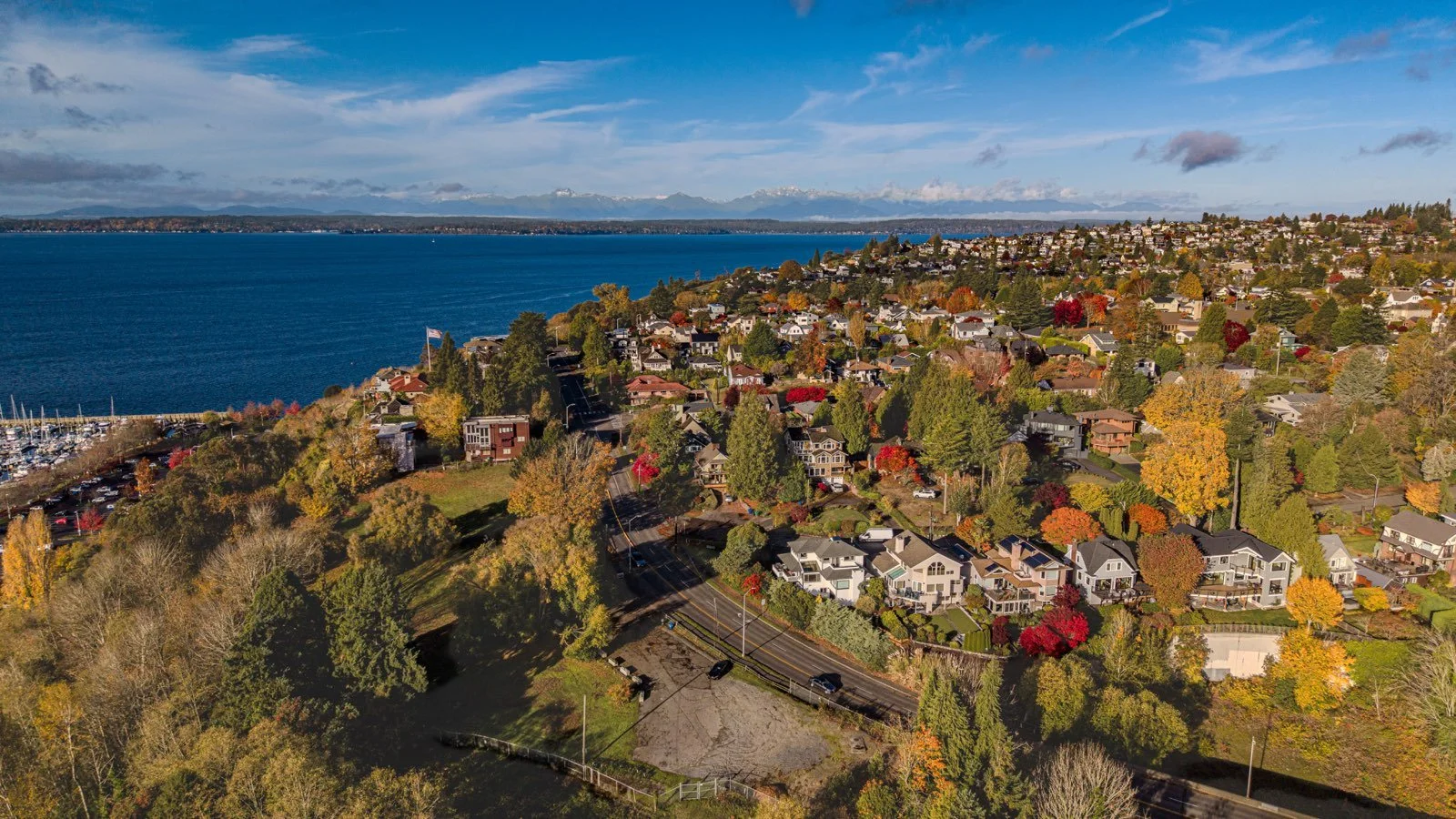
Photo by Brian J Johnson
Get Involved: Sign up for Ursula Judkins Legacy Notifications
Timeline
2026
The Seattle Department of Neighborhoods awarded a Small Sparks matching funds grant to the Ursula Judkins Legacy Project. MCC is the community sponsor for the group and Seattle Parks Foundation is the fiscal sponsor. The grant funds the group to work with interested community members, Karen Kiest Landscape Architects and Seattle Parks and Recreation staff to build community awareness for the 2024 Concept Plan and to plan kick start improvements to the gravel and asphalt area at the east end of the viewpoint. The immediate goal is to plan improvements that could be funded by a follow up Community Partnership matching fund grant next year.
2024
Seattle Parks and Recreation completed the Ursula Judkins Viewpoint Park Concept Plan in January 2024, following a public input meeting in November 2023. Parks provided $20,000 for outreach and preparation. The plan includes upgrades to the parking area, a walking path, improved overlook areas, restored meadows and invasive species management. Final design and implementation await funding in the Parks District capital budget. View the Concept Plan and full report on the Seattle Parks project page.
2023
Seattle Parks and Recreation commissioned Karen Kiest Landscape Architects to work with community members and Parks staff through a series of meetings to develop a Concept Plan for the viewpoint. The plan coordinates site reclamation, accessible parking and accessible pathways to a terrace at the east end of the park that celebrates the unique view.
2022
The FAA demolished the obsolete navigational structure at the east end of the viewpoint. Some fencing was removed and the demolition area was covered with gravel. The removal opened the east end of the park for public use, though the area remains compromised by uninviting gravel, concrete rubble and asphalt surfaces.
2022
The Seattle Department of Construction and Inspections approved a Conditional Use Permit for the Admiral's House site, and on December 20 the hearing examiner affirmed that decision. Ted and Jeanne Coulson made significant personal investments and worked tirelessly on the challenge, with MCC and Magnolia neighbors alongside them. While the community was not successful on every point, advocates secured important conditions: limits on view blockage from the proposed structures, a yew hedge buffer that must not exceed six feet and must be trimmed annually to five feet six inches, and removal of the proposed use of Parks property for access to the development.
2020
Ursula Judkins Viewpoint is officially listed by Seattle Parks and Recreation among the sixteen designated viewpoint locations in the city. This recognizes that view preservation and public view access are key features of the park, and marked another victory for park advocates.
2019
On May 10, the developer submitted the formal application for the two house project, including an Environmentally Critical Area Administrative Conditional Use application. The application requested access across Ursula Judkins Viewpoint property and proposed a site plan that would permanently block views of Elliott Bay from the east end of the site. Park advocates, with the support of MCC and others, challenged the biggest threats to the viewpoint and took legal action to remedy them.
2017
The developer began pre-application discussions with the Seattle Department of Construction and Inspections.
2013
In June, the historic Admiral's House property adjacent to the viewpoint was sold. As part of the sale agreement, a view corridor must be maintained from the southeast section of Ursula Judkins Viewpoint looking southeast across the Admiral's House.
2010
Park advocates were awarded a city grant to open the park, mitigate safety hazards and improve park functionality and beautification.
2009
Following community requests, and anticipating that the next owner might block park views, the Navy expressed clear intent to establish and maintain a view corridor in a January 31, 2009 letter. Once the property was sold, volunteers no longer had pruning access to the view blocking blackberry and weeds at the top of the slope. Uncontrolled plant growth has continued to erase one of the premiere viewpoints in the Northwest.
2007
A group of neighbors formed Friends of Ursula Judkins Park. The group received a $15,000 Small and Simple Project Fund grant from the Department of Neighborhoods and selected Karen Kiest Landscape Architects to lead a community design process. Their work established the viewpoint as one of sixteen designated viewpoints in Seattle, unique for its panoramic views of downtown Seattle, Mount Rainier, the Space Needle, the stadiums, West Seattle, Elliott Bay Marina, the grain terminal, Elliott Bay, Fourth of July fireworks, sailboat regattas, cargo ships, ferry crossings and the Pier 91 cruise terminal.
2003
The property was acquired from the Navy, along with the land that would become Smith Cove Park. This transfer was a direct result of Ursula Judkins' advocacy in the early 1990s, three years after her death.
1940s
The US Navy terraced the west end of the park and constructed temporary wartime structures. The abandoned driveway at the east end once led to the Admiral's House and the toe of the bluff near Smith Cove.
1930
Construction of the Magnolia Bridge.
1900s
John Charles Olmsted, of the Olmsted Brothers landscape architects, was hired by the City of Seattle to set aside and develop open space along a prescribed set of design principles. The Ursula Judkins Viewpoint site was a key part of the Olmsted plan for Magnolia Boulevard Park and Thorndyke Way. Seattle's Olmsted parks and roadways, this viewpoint included, represent one of the outstanding examples of Olmsted park systems in the United States.
Indigenous History
The Shilshole Duwamish, xa' tcoabc, had permanent settlements along the south shore of Salmon Bay, Pka dzEltcu. The viewpoint looks southeast across Elliott Bay, historically inhabited by the Duwamish people, who established at least seventeen villages along its shores. History of the Duwamish People
Remembering a Magnolia Icon
Ursula Judkins’s tremendous impact can still be felt in our Magnolia neighborhood today. Ursula Judkins Viewpoint Park welcomes visitors and community members home, situated at the top of the Magnolia Bridge, and boasting one of the best views of Downtown Seattle.
After moving to Magnolia with her family in 1968, she began her long legacy of work for the Magnolia Community. “From her tireless work to reduce the impacts of the West Point sewage-treatment plant, to resolving railroad noise in Interbay, creating the Shorelines Parks Improvement Fund, protecting Discovery Park and many other deeds, Mrs. Judkins was a local hero.” stated Mary Rothschild, Seattle Times assistant metro editor.
Additionally, Ursula Judkins worked to facilitate the construction of the Elliott Bay Marina, she established a neighborhood-led recycling movement that set the standard for such programs in Seattle, worked to reduce the impacts of the West Point sewage-treatment plant, lead efforts to mitigate noise pollution from trains travelling through Interbay, established the Shoreline Park Improvement Fund, that created support for Mounger Pool, and Discovery Park.
The City of Seattle has designated October 12th Ursula Judkins Day, in honor of our local hero. We celebrate her commitment to Magnolia and her extensive work that still benefits our community today.


Documentary about the late Ursula Judkins, community activist from the Magnolia Neighborhood in Seattle, Washington. Produced by Elizabeth Campbell for the Magnolia Neighborhood Planning Council.
-
![]()
Ursula Judkins is visiting the artist shop where the charming Discovery Park leaf patterned sidewalks were designed. She has been extremely active in the MCC and last year was the recipient of a special award for her outstanding service.
Photo and Caption from Magnolia Historical Society book, Magnolia: Memories & Milestones.
-
![]()
Ursula Judkins Viewpoint Park
-
![]()
View of Downtown Seattle during the 1962 Worlds Fair, from the future Ursula Judkins Viewpoint Park. Photo Credit: Union Pacific Railroad Collection
-
![]()
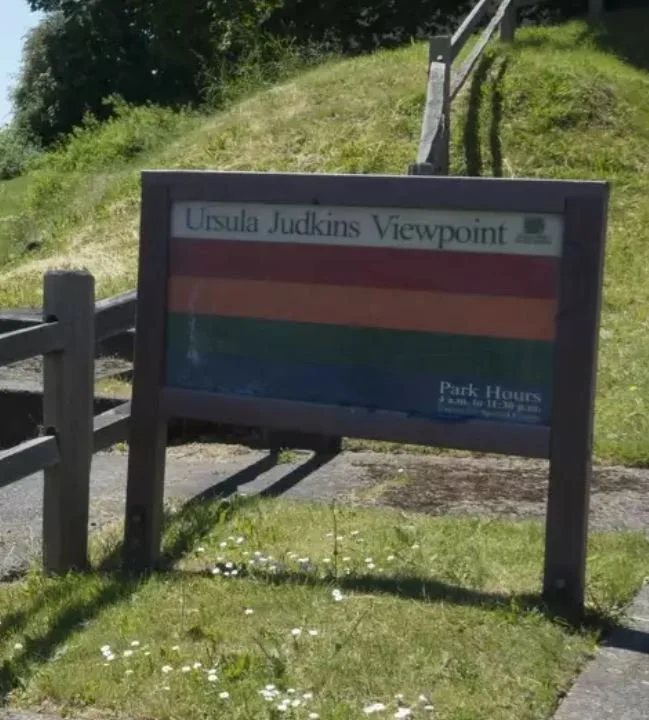
Ursula Judkins Viewpoint Park sign
-
![]()
In an image from more harmonious times, Magnolia Community Club member Ursula Judkins spears at the December 1995 inauguration of secondary treatment at the West Point Sewage Treatment Plan. Listening in the background are Metropolitan King County Councilmember Larry Phillips, D-Magnolia, and County Executive Gary Locke. Newspaper Photo and Caption Credit: Magnolia History Society
-
![]()
Cherry Blossoms blooming in Spring at Ursula Judkins Viewpoint Park
-
![]()
Sunset view of Downtown Seattle, from Ursula Judkins viewpoint Park




“She was a supreme community activist, who stayed on top of every issue and in touch with countless neighbors and government officials, even though she never owned a computer or fax machine. ”